About
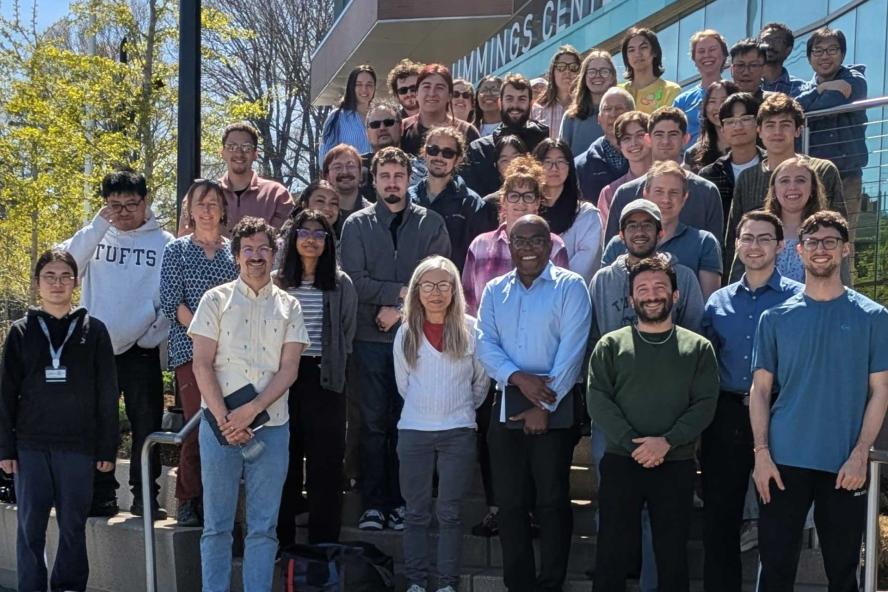
The Mathematics Department at Tufts is a community of scholars and students who study, teach, and create mathematics, from its theoretical foundations to its applications across science, engineering, computation, and data science.
We prepare undergraduate and graduate students to formulate and answer mathematical questions and to develop the insights, methods, and habits of reasoning needed to address problems across a broad range of mathematical areas and their applications. These include calculus, linear algebra, real analysis, abstract algebra, probability and statistics, partial differential equations, numerical linear algebra and numerical analysis, geometry and topology, number theory, and complex analysis. Students also develop an understanding of the role of hypotheses, conclusions, counterexamples, proofs, and other forms of mathematical evidence in the development and formulation of mathematical ideas.
Our department offers BA and BS degrees in Mathematics and Applied Mathematics, a Postbaccalaureate certificate in Mathematics, and MS and PhD degrees in Mathematics. We have an array of active student groups, a department colloquium, and several weekly research seminars. Our faculty's research spans many areas of pure and applied mathematics, and we offer a wide array of courses at all levels.
The Mathematics Department at Tufts University welcomes students with a wide range of backgrounds and experiences with mathematics. We extend a special welcome to those who have historically faced barriers to participation in mathematics, including people of color, women, LGBTQ people, and first-generation college students. We are committed to building a welcoming and supportive environment for all who want to join us in studying, teaching, and creating mathematics.
The Tufts Department of Mathematics has several research clusters representing areas of strength, including:
- Algebra, Representation Theory, and Algebraic Geometry
- Analysis and Partial Differential Equations
- Computational and Applied Mathematics
- Dynamical Systems
- Data Science and Artificial Intelligence
- Geometric Group Theory and Topology
- Probability
- Scientific Computing